Educational settings offer
Suicide Prevention Training for Schools
Preparing your staff for the conversations that may follow
From September 2026, revised Relationships, Sex and Health Education (RSHE) statutory guidance places greater emphasis on suicide prevention within secondary education.
The guidance recognises that schools may teach young people about suicide prevention, including how to recognise when they or someone they know may need support and where to seek help. It also makes clear that schools should plan carefully for this sensitive content and ensure that staff have the knowledge and skills needed to respond safely.
This creates an important question for schools:
If a lesson in school about suicide prevention leads a young person to approach a member of staff and say, “Can I tell you something?” Will your staff know what to say, how to respond and what to do next?
Curriculum education is an important part of suicide prevention. But education can also create opportunities for young people to disclose thoughts, feelings or experiences that they have previously kept to themselves.
Schools therefore need more than a well-planned lesson.
They need staff who feel prepared to notice concern, respond to disclosures and connect young people with appropriate support.
A whole-school approach to suicide prevention
Our Quality Training Offer for Schools provides two complementary levels of suicide prevention training.
Rather than expecting every member of staff to become a suicide intervention specialist, the approach recognises that different members of the school community have different roles and responsibilities.
The aim is simple: the right training, for the right people, at the right level.
The NALC Approach
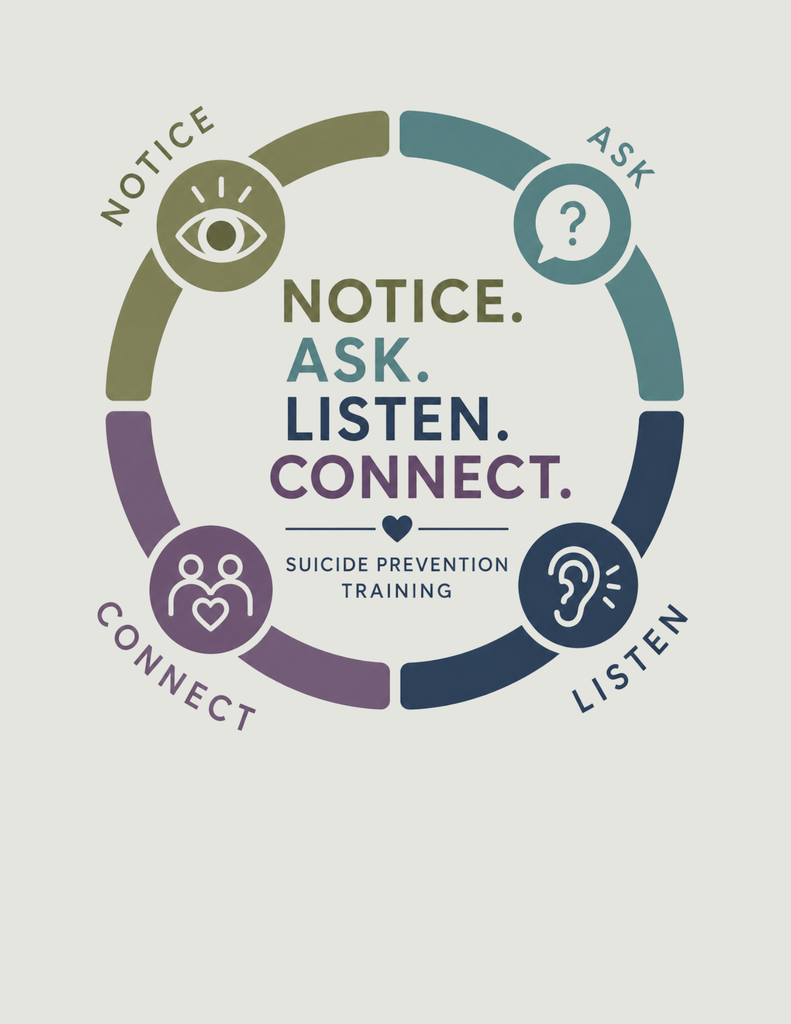
NOTICE, ASK, LISTEN, CONNECT
Suicide prevention skills for the wider school workforce
Notice, Ask, Listen, Connect is designed for the wider school workforce — including teachers, teaching assistants, pastoral staff, school leaders, administrative teams and other adults who may notice that a young person is struggling.
The training provides a simple, memorable framework for responding when concerns arise:
NOTICE
Notice verbal, behavioural and situational invitations that may indicate a young person is struggling or thinking about suicide.
ASK
Develop the confidence to ask directly and compassionately about suicide when there is concern.
LISTEN
Respond calmly, empathetically and without judgement, creating space for the young person to be heard.
CONNECT
Understand what to do next, including how to connect a young person with appropriate support and follow your school’s safeguarding procedures.
The purpose isn’t to turn every member of staff into a suicide intervention specialist.
It is to ensure that every adult has the confidence to respond safely when a concern, conversation or disclosure arises.
ASIST
In-depth suicide intervention skills for key members of staff in schools

ASIST – Applied Suicide Intervention Skills Training provides a more in-depth level of training for staff in school who have a specific role in responding to pupils experiencing thoughts of suicide or who may be at increased risk.
This may include:
- Designated Safeguarding Leads and safeguarding teams
- Pastoral leads and Heads of Year
- Mental health and wellbeing leads
- School counsellors and therapists
- Senior pastoral staff
- SENCOs and inclusion staff where their role includes responding to significant mental-health concerns
- School nurses and other healthcare professionals
- Other staff identified by the school as part of its suicide intervention response
ASIST develops practical suicide intervention skills, including working collaboratively with a pupil to increase immediate safety and develop a plan for keeping them safe.
Two levels. One consistent approach.
A whole-school approach doesn’t mean giving everyone the same training.
It means creating shared expectations, shared language and clear pathways for responding to concern.
THE WIDER SCHOOL WORKFORCE
↓
NOTICE, ASK, LISTEN, CONNECT
Building confidence to notice concern, ask about suicide, listen compassionately and connect a young person with appropriate support.
↓
KEY SAFEGUARDING, PASTORAL & WELLBEING STAFF
↓
ASIST
Developing more in-depth skills to intervene when a young person is experiencing thoughts of suicide or is at increased risk.
Together, the two levels can help schools develop a consistent, compassionate and appropriately skilled response across the school community.
Why suicide prevention training for school staff matters
The revised RSHE guidance acknowledges that young people may raise topics including self-harm and suicide and states that, where teachers have concerns about a pupil in relation to self-harm or suicidal ideation or attempts, safeguarding procedures must be followed. It also emphasises the importance of safe, preventative teaching that avoids instructive content, methods and potentially harmful material.
This means that preparing to teach suicide prevention is also about preparing for what may happen after the lesson.
A pupil may:
- ask a difficult or unexpected question
- disclose thoughts of suicide
- talk about a friend or family member
- indicate that they are struggling
- seek out a trusted adult for the first time
- reveal something that requires a safeguarding response
The person they approach may not be the DSL.
It may be a teacher, teaching assistant, receptionist, pastoral member of staff, lunchtime supervisor or another trusted adult.
That is why suicide prevention cannot sit solely with a small number of specialists.
Supporting your safeguarding responsibilities
Keeping Children Safe in Education (KCSIE) 2026 reinforces the principle that safeguarding is everyone’s responsibility. All staff are expected to understand their school’s safeguarding systems, recognise indicators of concern and act without delay when a safeguarding concern arises. The 2026 guidance also strengthens the recognition of the relationship between mental health concerns and safeguarding, including serious risks such as self-harm and suicidal ideation.
Our training is designed to complement — not replace — your school’s existing safeguarding policies, procedures and referral pathways.
It can support schools to:
- build staff confidence in talking openly and appropriately about suicide
- develop a shared language for suicide prevention
- reduce fear and uncertainty around asking about suicide
- strengthen compassionate listening and communication
- help staff understand their role when a concern arises
- reinforce appropriate escalation and safeguarding processes
- develop a trained core team with more in-depth intervention skills
- complement existing pastoral, safeguarding and mental-health provision
- support a consistent response across the whole school community
Every adult has a role in suicide prevention. Not every adult needs the same level of training.
Preparing your school for September 2026 and beyond
The introduction of suicide prevention content within the revised RSHE guidance provides an opportunity to look beyond the curriculum itself.
Ask:
What will happen when a pupil responds to that lesson?
Who will they talk to?
Will staff recognise the significance of what they are saying?
Will they feel confident asking directly about suicide?
Do they know what to do next?
Does your school have a clear pathway from concern, to conversation, to appropriate support?
Our Quality Training Offer can help you build that pathway.
Whether you are reviewing your RSHE curriculum, developing your whole-school mental-health approach, strengthening safeguarding provision or preparing staff for the introduction of suicide prevention education, we can help you consider which level of training is right for which members of your team.
The right training.
For the right people.
At the right level.
Talk to us about your school’s suicide prevention training needs.
Further information, pricing & availability
Have a question? Contact us to discuss how our training can best help you and to find out more about this and other courses.
ASIST Testimonials & feedback
Best thing I have ever done. Most valuable course and skills that I will take away with me for life. thank you so much.
ASIST Participant
Thank you so much, it’s made such a huge difference to how I believe I can deal with suicide. It’s a game changer.
ASIST Participant
ASIST has been incredibly helpful in providing a model and practical clear instruction on how to deal with a situation in which the persons contemplating suicide. It will inform my work and personal interactions around suicide going forwards completely
ASIST Participant
Help and Support with Thoughts of Suicide
If you are experiencing thoughts of suicide, there are a number of helplines you can contact such as:
HOPELineUK : 0800 068 4141
Shout Crisis Text service : Text 85258
Samaritans 116123
Visit our Help and Advice page for more information and support.
Associated courses
SafeTALK
4 hours
This 4-hour face-to-face course will teach you to become suicide alert. You’ll understand the many reasons why suicide can be missed, dismissed or avoided, increasing your alertness to the verbal and behavioural indicators that can be given by a person thinking about suicide, and how to connect them to someone who can help them keep safe.

Responding to Suicide Risk in the Workplace
1 day
Find out how to better support and your colleagues: What to look out for, how to intervene, keeping safe whilst providing support, what to do if a colleague takes their own life and more…
The NALC Approach
Notice. Ask. Listen. Connect
Notice, Ask, Listen, Connect (NALC) is a practical approach helping school staff confidently respond to pupils experiencing thoughts of suicide. In this 2 hour online or face to face workshop staff learn to notice concerns, ask directly, listen without judgement, and connect pupils safely with appropriate support.