LivingWorks ASIST — Frequently Asked Questions (FAQs)
What is ASIST?
ASIST stands for Applied Suicide Intervention Skills Training.
It is a two-day, face-to-face suicide intervention skills workshop developed by LivingWorks.
The programme is designed to help participants become more prepared to recognise when someone may be at risk of suicide, engage with them in a meaningful conversation and work towards immediate safety.
ASIST is an interactive programme rather than simply a lecture-based awareness course.
How long is ASIST?
ASIST is delivered over two days, comprising approximately 15 hours of training.
Participants need to attend the full workshop and actively participate to receive their CPD certificate of attendance.
Why does ASIST take two days?
Suicide intervention involves practical communication skills.
Understanding the theory is important, but it isn’t necessarily enough to feel prepared to have a conversation with someone who may be thinking about suicide.
The two-day ASIST workshop provides time for participants to explore the subject, consider attitudes and assumptions, learn the intervention framework and practise applying what they have learned.
Is ASIST just another suicide awareness course?
No.
Suicide awareness and suicide intervention are related but different.
Awareness training can help people understand suicide, recognise warning signs and know where to signpost someone for help.
ASIST goes further by developing intervention skills.
Participants learn and practise how to respond when someone may be at risk and how to work with that person towards immediate safety.
Do I need to be a mental health professional?
No.
ASIST is not only for people working in mental health.
Participants come from a wide range of professional, voluntary and community settings.
This can include education, counselling, health and social care, residential care, youth services, community organisations and many other environments.
You don’t need to be a therapist, counsellor or healthcare professional to attend.
Is ASIST suitable for school staff?
ASIST can be relevant for school and education staff who want to develop practical suicide intervention skills.
Schools can face situations where a member of staff becomes concerned about a pupil, colleague or family member.
ASIST can help participants develop greater confidence in having conversations about suicide and responding appropriately.
If you’re considering ASIST for a school or education team, contact us to discuss your requirements.
What will I actually do during the two days?
ASIST is designed to be interactive.
You’ll be involved in activities, discussion, exploration and practice rather than simply listening to presentations.
The workshop gives you opportunities to explore attitudes towards suicide, understand the experience of a person at risk, learn the ASIST intervention framework and practise applying the skills you’re developing.
The precise activities and delivery follow the LivingWorks ASIST programme.
Will I have to talk about my own personal experiences?
ASIST explores a sensitive subject and participants may have personal experiences of suicide, either directly or through people they know.
You will be encouraged to participate in the workshop, but you should not feel that you have to disclose personal experiences that you would prefer to keep private.
If you have concerns about whether the course is right for you at this time, please contact us before booking.
Is ASIST suitable if I have never worked with someone who is suicidal?
Yes.
In fact, one of the reasons people attend is to feel more prepared before they encounter a situation involving suicide.
You don’t need previous experience of suicide intervention.
The workshop is designed to introduce and develop the skills required.
Will ASIST make me a counsellor or therapist?
No.
ASIST is suicide intervention skills training. It does not qualify participants as counsellors, therapists, psychologists or mental health practitioners.
It gives participants skills and a structured approach for responding to someone who may be at risk of suicide.
What will I be able to do after ASIST?
The aim is for participants to be more ready, willing and able to respond when someone may be at risk of suicide.
You will have learned about the ASIST intervention framework and had opportunities to practise using the skills during the workshop.
As with any skill, confidence and competence develop through continued learning, practice and experience.
Is ASIST evidence-based?
ASIST is a programme developed and delivered by LivingWorks, which has a long history in suicide prevention training.
If you require detailed information about the research evidence, evaluation and programme development, we recommend referring to the current LivingWorks information and research materials.
Learn more about LivingWorks ASIST →
Is ASIST recognised internationally?
Yes.
LivingWorks delivers its suicide prevention and intervention programmes internationally, and ASIST has been delivered in many countries.
Do I receive a certificate?
Yes.
Participants who attend the full 15-hour workshop and actively participate receive a CPD certificate of attendance.
Please note that a certificate of attendance is not the same as a professional qualification.
Is ASIST the “gold standard” for suicide intervention?
LivingWorks describes ASIST as its gold-standard suicide intervention programme.
We prefer to let the programme’s structure and the experience participants have during the two days demonstrate its value.
The key difference is that ASIST isn’t designed simply to give you information about suicide.
It gives you the opportunity to practise intervention skills.
How much does ASIST cost?
The cost varies depending on the individual workshop.
For group bookings or workplace training, contact us for details.
Can you deliver ASIST for our organisation?
If you are interested in arranging ASIST for a school, workplace, charity, community organisation or professional team, please contact us.
We can discuss your requirements, potential dates and delivery options.
Enquire about group training →
What should I do if I’m worried about someone right now?
ASIST is a training programme. It isn’t a substitute for emergency or professional support.
If you are currently concerned that someone is at immediate risk of suicide, seek appropriate urgent help rather than waiting for a training course.
If you’re unsure what to do, contact the appropriate emergency, health or crisis service in your area.
Still have questions?
If you’re considering ASIST but aren’t sure whether it’s right for you or your organisation, we’re happy to help.
Ask us a question before you book.
Be prepared for the conversation you hope never happens.
You may never know when someone will tell you they’re thinking about suicide.
But you can choose to be better prepared if they do.
Don’t just learn suicide intervention. Practise it.
LivingWorks ASIST — two days that could change how you respond when it matters.
Further information, pricing & availability
Have a question? Contact us to discuss how our training can best help you and to find out more about this and other courses.
ASIST Testimonials & feedback
Best thing I have ever done. Most valuable course and skills that I will take away with me for life. thank you so much.
ASIST Participant
Thank you so much, it’s made such a huge difference to how I believe I can deal with suicide. It’s a game changer.
ASIST Participant
ASIST has been incredibly helpful in providing a model and practical clear instruction on how to deal with a situation in which the persons contemplating suicide. It will inform my work and personal interactions around suicide going forwards completely
ASIST Participant
Help and Support with Thoughts of Suicide
If you are experiencing thoughts of suicide, there are a number of helplines you can contact such as:
HOPELineUK : 0800 068 4141
Shout Crisis Text service : Text 85258
Samaritans 116123
Visit our Help and Advice page for more information and support.
Associated courses
SafeTALK
4 hours
This 4-hour face-to-face course will teach you to become suicide alert. You’ll understand the many reasons why suicide can be missed, dismissed or avoided, increasing your alertness to the verbal and behavioural indicators that can be given by a person thinking about suicide, and how to connect them to someone who can help them keep safe.

Responding to Suicide Risk in the Workplace
1 day
Find out how to better support and your colleagues: What to look out for, how to intervene, keeping safe whilst providing support, what to do if a colleague takes their own life and more…
The NALC Approach
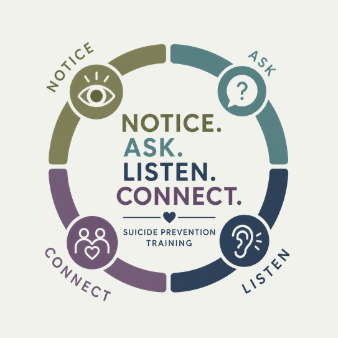
Notice. Ask. Listen. Connect
Notice, Ask, Listen, Connect (NALC) is a practical approach helping school staff confidently respond to pupils experiencing thoughts of suicide. In this 2 hour online or face to face workshop staff learn to notice concerns, ask directly, listen without judgement, and connect pupils safely with appropriate support.